
An evolving record of Gustav Reyes’s work, from the earliest wooden-ring experiments and Simply Wood Rings through the development of his contemporary art-jewelry practice.
The archive is being organized from surviving studio files, photographs, press materials, correspondence, website backups, and published sources. Dates and identifications are kept conservative: when the record does not support a claim, the archive leaves it open.
2005 · Later studio records place the beginnings of the wooden-ring practice in Reyes’s basement woodworking shop, where early experiments gradually developed into a structurally refined bent-wood ring.
January 2006 · The earliest surviving email record links directly to Etsy listing 57306 and the Craftsman Etsy shop. The original listing image has not yet been recovered.
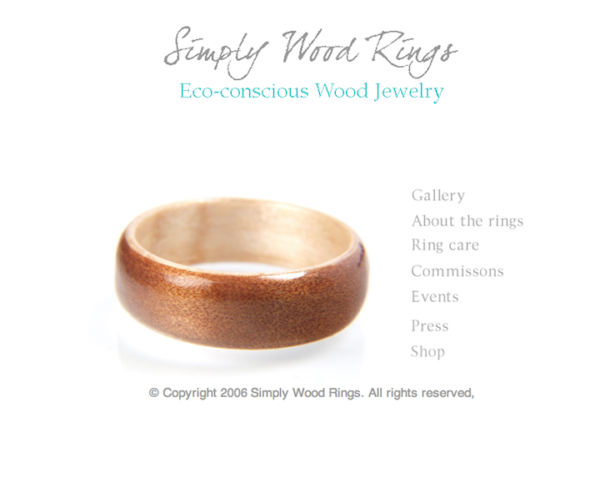
February 2006 · A surviving banner for Simply Natural Wood Rings documents an early identity between the initial Etsy period and the later Simply Wood Rings name.
July 2006 · A surviving store record shows the named design Two Lovers and an Acorn already in use, evidence that symbolic and narrative titles were part of the work from an early stage.
December 2006 · The earliest recovered camera-dated ring photograph in the archive records a laminated wooden band with a pale inner liner. It is preserved by date rather than assigned a design name that the source does not provide.
2007–2008 · Surviving photographs, press references, and a 2008 media kit show the practice expanding beyond the idea of a conventional wedding band. The jewelry is already described through reuse, material history, structure, environmental responsibility, and wearable sculpture.
2009 · In a personal studio draft written after the New York Times feature “Warm, Honest, Wooden,” Reyes identifies the impermanence of wood, and life as a process of growth and decay, as central to his connection with the material.
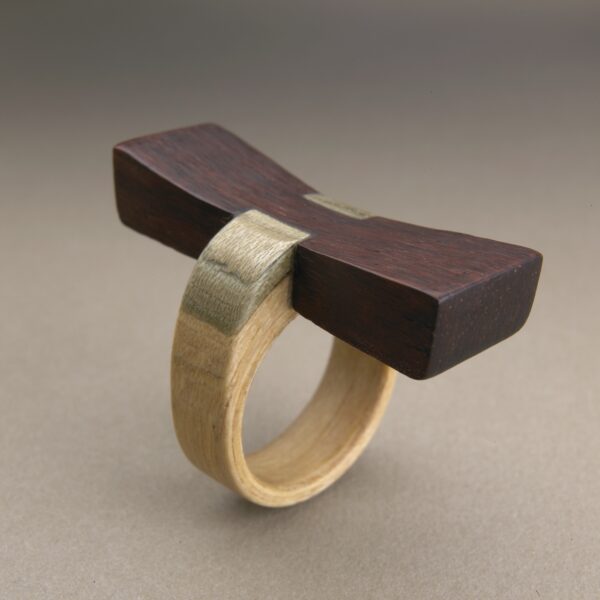
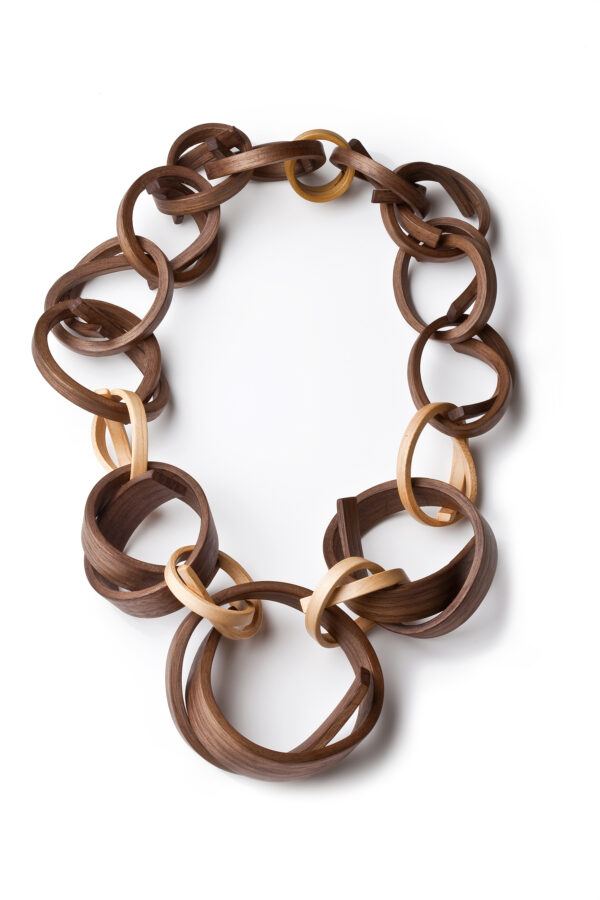
Material memory. Salvaged wood is not treated as neutral stock. Earlier use, place, age, structure, and association enter the new object.
Impermanence. Wood makes time visible. Its capacity to change, respond to the environment, and eventually return to the earth became a way to think about mortality, presence, and value.
Body and adornment. Jewelry remains important because the wearer completes the work. The object moves from the maker into another person’s life and acquires new meaning there.
Hand and technology. Steam bending, lamination, hand tools, compressed wood, laser cutting, CNC processes, and 3D printing belong to one continuum when they open a more direct relationship with material.
Evolution rather than collection. Early interviews describe the practice not as a predetermined series but as an evolution: technical problems led to new forms, and those forms gradually opened conceptual questions.
The First Years · 2005–2008 →
A closer look at the surviving records that trace the wooden-ring practice from the Etsy era toward sculptural contemporary jewelry.
2008 · Simply Wood Rings media kit — art, wearable sculpture, reclaimed material, grain, and ecological responsibility.
2009 · Studio and blog drafts — stillness, present time, impermanence, growth and decay.
2011 · Long-form interview questionnaire — creation as a biological human impulse; material, memory, adornment, technology, and the studio environment.
2012 onward · Published interviews and features in Metalsmith, Ornament, American Craft, institutional writing, and later studio records.
Read selected press and writing →
This archive is ongoing. Historical images and texts will be added only when their dates and provenance can be documented responsibly.