
2008–2018
During this decade, the structural language that began with the wooden ring widened into a broader investigation of the body, material memory, repetition, scale, and fabrication. The work moved outward from the finger into neckpieces, brooches, sculptural forms, lighting, and furniture, while the questions at its center remained closely related: how wood carries time, how a body completes an object, and how making can hold both handwork and contemporary technology.
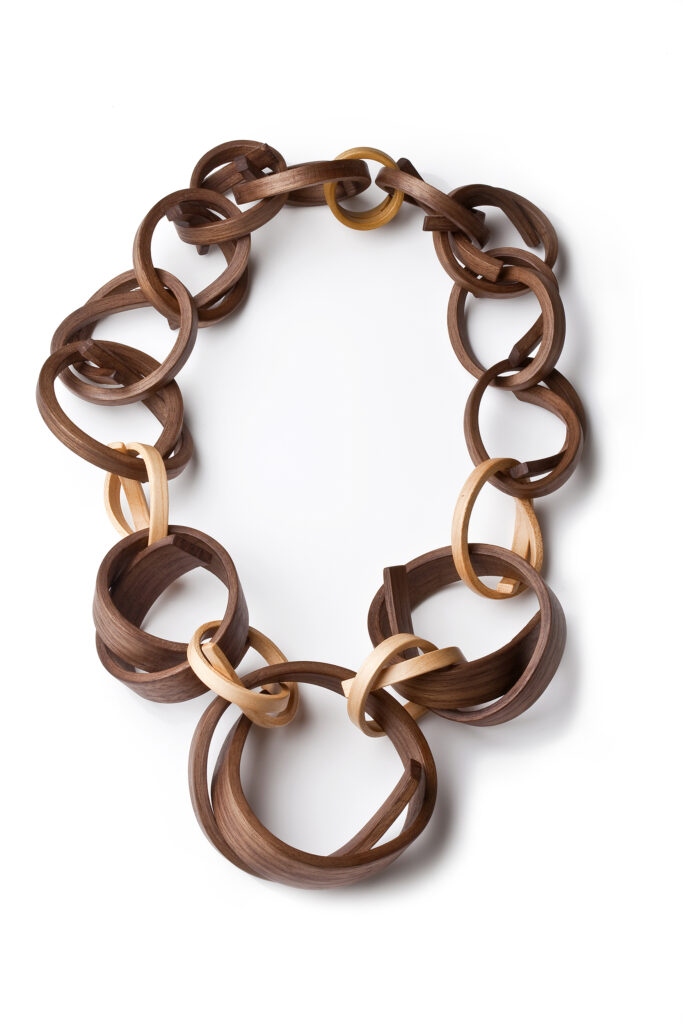
By 2010, works such as Tie Me Not were carrying the logic of bending and repetition beyond the ring. Later neckpieces in the 360 Series and works such as The Held continued that movement, treating jewelry less as an isolated object and more as something completed through its relationship with the body.
The Ad Idem works made the prior life of material increasingly explicit. Salvaged wood was not approached as neutral stock; its previous use, age, associations, and physical history became part of the object. A 2016 studio inventory also documents Ad Idem works combining salvaged wood with 3D-printed elements, showing that historical material and contemporary fabrication were already being brought into the same conversation.
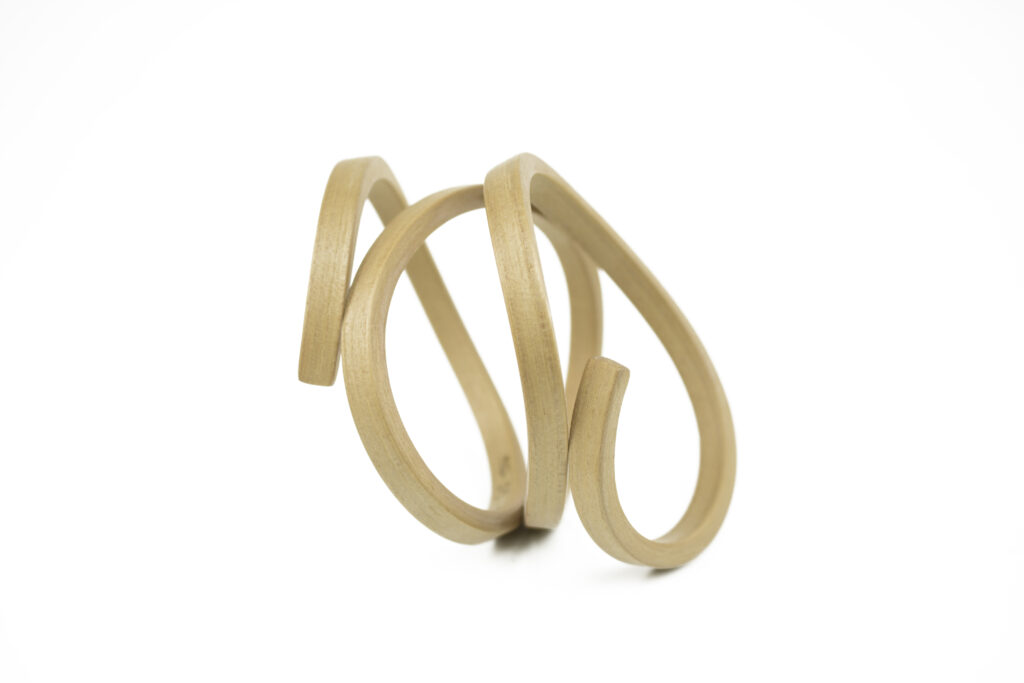
Organic Coil and Arc Series works developed bending into a visible structural language. Curves were no longer only a solution to making wood wearable; they became a way of building tension, rhythm, volume, and space. Brooches, necklaces, and repeated coil forms allowed the material to behave somewhere between jewelry, drawing, and small sculpture.
The same questions also moved beyond jewelry. Walking Series sculptures, cold-bent tables, and Arc Series lighting tested related ideas at larger scales. These works are included in the archive selectively—not as a separate furniture or design practice, but as evidence that the studio was using scale to test the same material and structural vocabulary.
Traditional woodworking and contemporary fabrication increasingly occupied the same continuum. Bending, laminating, hand tools, metal components, digital processes, and 3D printing were used according to what the work required. Technology did not replace the hand; it expanded the range of forms and relationships that could be explored without losing direct contact with material.
Outward Expression, 2012 →
A Historical Record, 2012 →
Woodworker… it’s an honest word. — Sam Maloof, 2011 →
Press & Writing →
The questions developed here continue in current works including The Interval Brooch, Open Coil Brooch, and Held Knot Neckpiece.
This page is part of an archive in development. Additional works and images will be added only when their dates, materials, and provenance can be documented responsibly.